
Why Startups Upgrade Their Domain Name: The Best Domain Extension for the Brand, and When It Isn't Worth It
Almost every young company launches on a compromise address. The perfect .com was taken, the budget was zero, and the team needed a website by Friday, so the founders added a word in front of the name, picked a newer ending, or both. For a while that works. Then the company raises money, hires, signs bigger customers and starts to sound like the name on its pitch deck, and the address starts to look like a placeholder.
That gap is what a domain upgrade closes: moving from the address the company could get at launch to the version of its own name that people expect to type. It is one of the few branding changes that can be done in a week, and one of the easiest to get wrong, because the price, the timing and the move itself all matter.
This guide covers why founders upgrade, the two kinds of upgrade, how the system of web endings works, what upgrades cost based on the prices listed on NameEstate's index today, when an upgrade is not worth the money, and how to move to a new address without losing search traffic or email. Every company example below is a real company on the index, with its actual upgrade and the date its price was checked.
What a Domain Upgrade Means
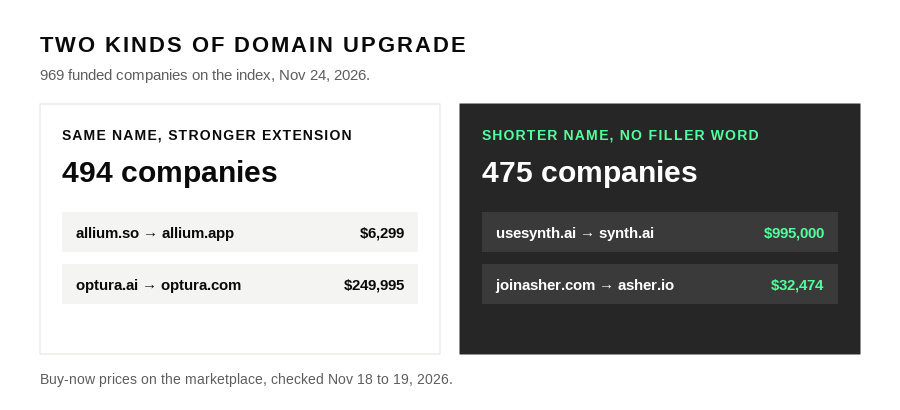
A domain upgrade is a switch to a stronger domain for the same company name. It comes in two kinds, and the index tracks both:
- Same name, stronger extension. The company keeps its name and moves to an ending that is simpler to recall or more expected, for example from allium.so to allium.app, or from optura.ai to optura.com.
- Shorter name. The company drops a filler word such as get, try, use, join or go, for example from usesynth.ai to synth.ai, or from joinasher.com to asher.io.
Of the 969 funded companies listed on the index on Nov 24, 2026, 494 have a same-name upgrade on offer and 475 have a shorter-name upgrade. The index only lists a company when a better address is actually available to buy or register, so these are real options with real prices, not wish lists.
An upgrade is not a rebrand. The product, the logo and the company name stay the same. Only the address changes, which is why it can be done without a design agency or a launch campaign. A full rebrand, where the name itself changes, is a much larger project with its own guide.
Why Founders Launch on a Workaround Domain Name
Very few teams choose a compromise domain on purpose. It is usually the result of three facts that are true at launch and stop being true later.
The good version is taken. Short, real words on the most common endings were claimed long ago, and many are held by owners who resell them. When a founder searches for the name and sees it is taken, the quickest fix is a prefix or a different ending.
Money is better spent elsewhere. Before a first round, a five-figure purchase competes with salaries and servers. A new variant costs the price of a lunch, and the team can ship the same day.
Nobody knows the company yet. With no customers and no press, the cost of an awkward address is close to zero. Nobody mistypes a name they have never heard.
All three change after a raise. The company has money, people are starting to say its name out loud, and every new customer, candidate and investor has to remember a slightly odd spelling. That is why the months after a funding round are a natural time to consider an upgrade, and why the index pairs each company's reported funding with its upgrade.
Five Reasons Companies Upgrade
The reasons founders give tend to fall into five groups. None of them comes with a guaranteed number attached, and anyone who promises a specific lift in traffic or trust from a new address is guessing. What can be said is where the friction sits.
1. The first impression of the address
An address is often the first part of a company a stranger sees: in an email signature, a calendar invite, an investor update or a search result. A short, plain address reads as an established company. A long address with a filler word reads as a company that settled. That effect is hard to measure, but it is part of every interaction before a call even starts.
2. Word of mouth and typing the name
When a customer recommends a product over coffee, the listener has to turn a spoken name into an address. If the company is called Monte but lives at trymonte.ai, the listener has two chances to get it wrong: the prefix and the ending. Names that are easy to remember and easier to type lose fewer people between hearing the name and landing on the site.
3. Email that matches the company
Email addresses inherit the web address. A sales rep writing from a long, prefixed address spends a second of every introduction explaining the name, and a mistyped address means a message that never arrives. For many teams, email is the most visible daily cost of a prefixed address, because it touches every customer and every hire.
4. Owning the name in full
While someone else holds the plain version, that owner can sell it to anyone, including a competitor or a company that wants to look like yours. Holding the exact name is part of protecting the brand name, alongside a trademark. That legal right covers how a name is used in commerce; the web address is a separate asset that has to be bought.
5. Clean search and type-in visits
People who already know the company often type the plain name straight into the browser. If that plain address belongs to someone else, part of that direct traffic goes to them. Upgrading closes the leak and puts the whole name under one roof.
None of these reasons applies equally to every company. A developer tool sold through a marketplace depends less on its address than a consumer brand that grows by word of mouth. The test is how often a person has to type or say the address before they buy.
What Your Domain Name Says About Your Brand
A web address is part of your brand in the most literal sense: it is the one piece of a company's online identity that appears everywhere, from the footer of every email to the link in every post. A great name on an awkward address sends a mixed signal. The name says the company knows what it is; the address says it had to settle.
Consider how people recognize your brand online. They see the logo now and then, but they see the address every time they log in, open an invoice or share a link. Over months, the address becomes part of the brand’s identity as much as the colors or the tagline. That is why founders who care about a strong online presence treat the domain name as a brand asset rather than a technical setting.
The same logic explains the real value of a clean address in marketing efforts. Every campaign, podcast mention and conference badge ends with someone typing the name. An address that matches the company's name and extension, with nothing to explain, makes each of those efforts work a little harder. It does not replace a good product or a clear message; it removes a small tax on both.
Before you think of a business name as final, check that the address can carry it. The purpose of your website is to turn a name someone heard into a visit, and anything in the address that gets in the way works against that purpose. An address that reads cleanly also helps make your website feel like the company's home rather than a temporary page, which matters for an online brand that wants buyers and investors to take it seriously.
Dropping the Get, Try or Use: From getX.com to X.ai
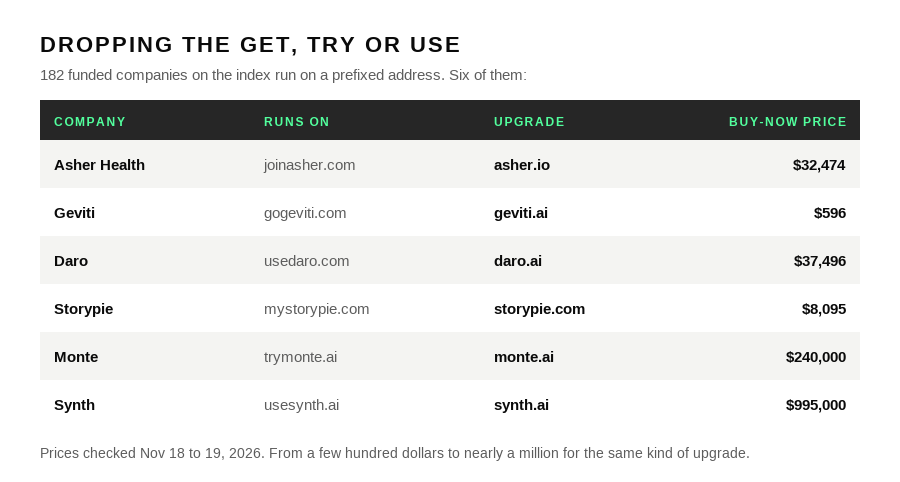
The most common upgrade on the index is the simplest one: removing the filler word. Of the funded companies listed today, 182 run on an address that starts with a filler word such as get, try, use, join, go or my, and each has a version without it on offer. Some current examples, with prices checked between Nov 18 and Nov 19, 2026:
- Asher Health runs on joinasher.com; asher.io is listed at $32,474.
- Geviti runs on gogeviti.com; geviti.ai is listed at $596.
- Daro runs on usedaro.com; daro.ai is listed at $37,496.
- Storypie runs on mystorypie.com; storypie.com is listed at $8,095.
- Monte runs on trymonte.ai; monte.ai is listed at $240,000.
- Synth runs on usesynth.ai; synth.ai is listed at $995,000.
The examples show why there is no single answer to whether dropping the prefix is worth it. For Geviti, the short name costs a few hundred dollars. For Synth, the exact match is priced like a small acquisition. Both companies get the same benefit, the bare name, at prices three orders of magnitude apart.
The bare name does not have to be on the same ending. A company on getX.com can move to X.ai or X.io, trading the most expected ending for the shorter name. Whether that is a step up depends on the audience: for an AI product, X.ai is a natural fit, while for a consumer brand the plain .com usually remains the stronger choice.
Same Name, Stronger Extension
The other route keeps the name and changes the ending of the domain. Many companies launch on a newer ending such as .so, .health, .bio, .build or .energy because the .com of their name was taken. Later, a more familiar ending of the same name becomes available, or worth buying.
Examples from the index, prices checked Nov 19, 2026:
- Allium Labs runs on allium.so; allium.app is listed at $6,299.
- Optura runs on optura.ai; optura.com is listed at $249,995.
- Onyx Bio runs on onyx.bio; onyx.com is listed at $2,995,000.
Among the upgrades on the index, the most common target endings are .si (223 companies), .ai (216), .com (194), .io (150), .app (132) and .co (54). The spread shows that an upgrade does not have to mean .com. For many companies the realistic step up is the same short name on .ai, .io or .si, at a fraction of the .com price. The extension guides cover each ending in detail, with the domain prices for each.
Tech Startups, Keywords and Search Results
For tech startups, the address is often the first thing an investor, a candidate or a buyer checks. It appears in the pitch deck, in the data room and in the first message to a target market, and it is where internet users land when they search for the company by name.
A common question is whether the address should contain a keyword, such as a product category after the name. Exact-match keyword addresses were once a popular shortcut, but search engines judge pages mainly on their content and on who links to them, not on the words in the address. A keyword can still help people understand what a company does at a glance, which may help click-through rates on searches with commercial intent, but no reliable source puts a number on it. For most companies, a short brand name beats a long phrase.
Search engines also treat a move between addresses as a normal event when it is done properly, so fear of losing rankings should not, on its own, keep a company on a weak address. The section on moving below covers how to keep search traffic during the switch.
How a Top-Level Domain Works: TLDs, Country Codes and the Domain Registry
To judge an upgrade, it helps to know what the ending of an address actually is. The part after the last dot is the TLD. Endings fall into two main groups:
- Generic TLDs, or gTLDs, such as .com, .app and .dev, which anyone can use for most purposes.
- Country-code TLDs, or ccTLDs, which are assigned to countries and territories but are often used for other reasons. Two of the most popular with tech companies are .ai, the country-code top-level domain of Anguilla, and .io, assigned to the British Indian Ocean Territory.
Each ending is run by a registry, the organization that keeps the master list of names under it and sets its rules. Companies buy names, and pay each yearly renewal, through a registrar, which passes the order on. That is why prices and rules differ from one ending to the next: some endings cost more for short or popular names, some limit who can register, and some country codes are open only to local residents, a rule a local ccTLD can set.
Three practical points follow for founders:
- Names are rented, not owned. A name is paid for year by year. If the payment method on file fails and the name is allowed to lapse, someone else can register it. Turn on automatic renewal and keep the billing details current; it is the simplest way to renew your domain name on time.
- Country codes depend on their country. An ending tied to a country is ultimately governed by policies set for that country, which is worth knowing before building a company on one.
- Two-letter endings are mostly country codes. If an ending has two letters, it is almost always a country code, even when it is marketed as a brand ending.
What a Domain Upgrade Costs: Prices on the Index
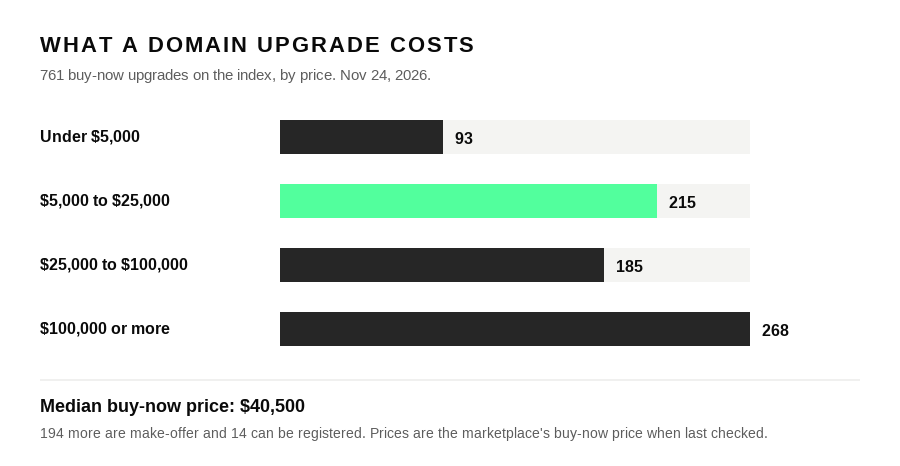
The index lists the buy-now price of each company's best available upgrade, as the marketplace showed it when last checked. As of Nov 24, 2026, 761 of the 969 listed companies have an upgrade with a buy-now price. The rest are listed with a make-offer price (194) or are open for registration at the registry's premium price (14).
Across the 761 buy-now upgrades, the median price is $40,500. The spread is wide:
- 93 upgrades are priced under $5,000.
- 215 are priced from $5,000 to $25,000.
- 185 are priced from $25,000 to $100,000.
- 268 are priced at $100,000 or more.
The price depends mostly on three things: how short and common the word is, how popular the ending is, and whether anyone else would want the name. A one-word .com is the most expensive category by far; the same word on a newer ending is often a small fraction of it. Prices change, and a name sold to someone else disappears from the market, so every price on the index carries the date it was last checked.
How the Index Finds a Better Domain for Each Company
The upgrades in this guide come from a simple, repeatable check. For every company on the index, the domain it runs on today is compared with two kinds of alternative: the same name on stronger endings, and the name without its prefix on the common endings. Each candidate domain is then checked for its status.
- Listed for sale. The domain is on a marketplace with a buy-now price, which the index records with the date it was checked.
- Open to offers. The owner lists the domain but wants an offer instead of a fixed price.
- Free to register. Nobody holds the domain, and it is priced as premium.
- Held, not for sale. Someone owns the domain and has not listed it. These are not shown, because there is nothing to act on.
Only the first three appear on a company's page, with the strongest option first. That keeps every upgrade on the index actionable: a founder who opens the page sees a domain that can actually be bought or registered, the marketplace that has it and what it cost when last checked. Prices are checked again on a schedule, and a domain that sells or leaves the market drops off the page.
The method also explains what the index does not claim. It does not estimate what a domain is worth, rank one ending above another for every company, or predict how much traffic an upgrade would bring. It shows what is available for each funded company's name today, so the decision rests on real options instead of guesses.
When a Domain Upgrade Isn't Worth It
An upgrade is a purchase like any other, and sometimes the right answer is to wait or to skip it. It is usually not worth it when:
- The price is out of proportion to the round. If the upgrade would take a large share of the cash raised, the money is likely better spent on hiring and product. A company can upgrade later, when the business grows.
- The name itself may change. If the team is still testing positioning, buying the perfect address for a name that might not survive the year is premature.
- The audience never types the address. Products sold through app stores, marketplaces or integrations often get almost no visits from people typing the address, so it matters less.
- The current address already works. A distinctive name on a clear ending, without a prefix, may already be easier to remember than the alternatives. Upgrading from a good address to a slightly better one rarely changes anything.
- The available version carries risk. If the better address has a trademark conflict, a bad history or an ending with restrictive rules, the upgrade can create more problems than it solves.
Skipping the upgrade today does not mean giving up on it. A company can secure the bare name on a newer ending to keep it out of other hands, set it to forward to the current site, and watch the listing for the stronger version. Prices on the market move, owners change their minds, and a name that is too expensive before a seed round can look reasonable after a Series A. The index rechecks prices on a schedule, so a company page always shows the latest known price and date.
A useful rule of thumb: an upgrade earns its price when people say, type or email the company's name many times a day, and when the current address makes them hesitate.
How to Choose the Best Domain Extension for Your Company
When the .com is out of reach, the choice comes down to which ending fits the company and its audience. There is no universal ranking of endings, but a few questions narrow it quickly:
- Who types the address? Consumers default to .com. Developers and technical buyers are used to .io, .dev and .ai.
- What does the ending say? .ai signals artificial intelligence, .app a product you install or use, .health or .bio a field. If the ending matches the product, it becomes a feature rather than a compromise.
- Is it a country code? Check the rules for that ending and any local requirements before building on it.
- Can you get the bare name? Mark.ai is often a better address than getmark.com. A short name on a fitting ending can beat a long name on the most common one.
- What will renewal cost? Some endings carry high yearly prices, and premium names can carry premium renewal prices.
Choosing a domain extension also means looking at the domain extensions available for your exact name. If the .com domain is listed at a price you can live with, it is usually the safest choice, because the .com extension is the ending most people assume. If not, compare the bare name on .ai, .app or .si with the prefixed .com. Choosing the right domain name is a trade between those answers and the price, and the decision should hold for the next five years rather than this quarter.
The extension pages on NameEstate show, for each ending, how many funded companies use it and what upgrades to it currently cost, which makes it easier to pick the right fit with real numbers.
Domain Registration vs Buying a Taken Name: Is It Available for Registration?
There are two ways to get a better address, and they work very differently.
Registering a free name. If nobody holds the name yet, it can be registered immediately, at the standard price or, for names priced as premium, at a higher fixed price. A WHOIS lookup or a search at a registrar shows whether the name is available, and a domain that shows as taken there may still be for sale on a marketplace. Of the upgrades on the index, 14 are open for registration today.
Buying from an owner. Most good names already have owners. When an owner lists the name on a marketplace with a buy-now price, the purchase works like any online checkout, with the marketplace holding the payment until the name is transferred. When there is no listing, the buyer has to find the owner, make an offer and agree on a price, often through a broker or an escrow service. Names listed with a make-offer price sit in between: the owner wants to sell, but the price is negotiated.
For founders who prefer not to reveal who is buying, a broker can approach the owner without naming the company, so the asking price is set without knowing who the buyer is.
DNS, Hosting and the Technical Side of an Upgrade
Buying the better name is only half the job; it then has to point somewhere. The Domain Name System (DNS) is the address book that tells browsers and mail servers where a name lives. After a purchase, the new owner sets records at the registrar or at a DNS provider: one set for the website, one for email, and one for any service that sends mail on the company's behalf.
Most hosting solutions make this a few clicks: add the new name to the existing site, issue an SSL certificate, and serve the same pages on the new address. Many teams use open-source tools or their host's dashboard to confirm that every record resolves before switching.
Anything that runs under the old address needs the same treatment. A company that serves its app, docs or help center from subdomains such as app.oldname.com has to recreate each one on the new name and forward it. A single forgotten piece is a common cause of broken links after a move.
Keep the old address in the same account as the new one, with the same billing settings, so both registered domain names are managed together and neither expires by accident.
Moving From the Old Domain to the New Domain: Redirect Without Losing SEO
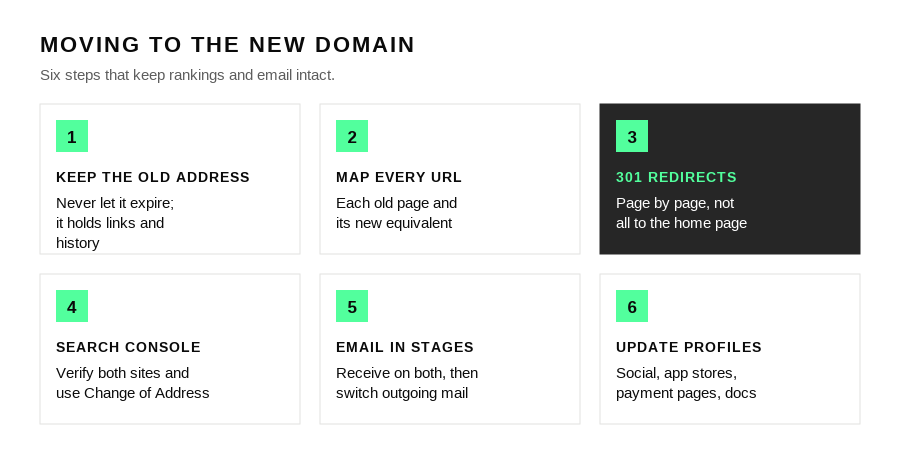
The move itself is where most of the risk sits. Done carefully, rankings and email come across with little disruption. Done carelessly, a company can lose traffic for months. The core steps:
- Keep the old address. Never let the old name expire after a move. It holds links, bookmarks and the history search engines have built up, and it should stay active for years.
- Map every URL. List each page on the old site and the matching page on the new one.
- Set up permanent 301s. Point every old URL to its new equivalent with a 301 redirect, page by page, not everything to the home page. This is how a search engine learns that the content moved.
- Tell Google. Verify both sites in Google Search Console and use its Change of Address tool, which exists for exactly this kind of move.
- Move email in stages. Add the new address to the email system first, keep receiving mail on the old one, and update signatures, invoices and logins before switching outgoing mail.
- Update the places you control. Social profiles, app store listings, payment pages and documentation.
A short wait in rankings after a move is normal; page-level forwarding and the change of address keep it short. The longer guide to naming a business covers checks to run before a name goes on anything permanent.
Legal and Financial Checks Before You Buy
A better address is an asset, so treat the purchase with the same care as any other asset. Three checks catch most problems:
- History. Look at what the name was used for before. Archived copies of old pages show whether it hosted spam, adult content or a business with a poor reputation, which can follow a name for years.
- Rights. Make sure no other company holds rights to the name in your field. A conflict can cost a company the name after it has paid for it.
- Paper trail. Buy through a marketplace or an escrow service, get a receipt in the company's name, and record the purchase as a company asset rather than a founder's personal expense. The name should be held by the company, not by an employee who might leave.
None of this needs to slow a purchase down. A history check and a rights check take a day, and the escrow process takes care of the money.
Upgrades and Small Businesses
Most of this guide is written for venture-backed tech companies, but the same logic applies to small businesses (SMBs). A local firm that launched on a hyphenated or keyword-stuffed address faces the same trade: the cost of the better name against how often customers type it. For a business that mostly gets found through maps and referrals, the address matters less; for one that sells online, it matters more.
The steps are the same as for a funded company: check the history of the better name, buy through a marketplace or escrow, forward every old page, and keep the old address active. The main difference is scale. A small firm usually has fewer pages, fewer integrations and fewer people sending email, so the move can often be done in an afternoon.
What changes is the budget. Such a firm rarely needs a premium one-word name. The upgrade is often a shorter, cleaner version of its own company name on a familiar ending, which tends to be affordable.
A Founder's Checklist Before You Upgrade
- Write down the current address and every place it appears: site, email, documents, profiles.
- Decide which kind of upgrade you need: same name on a better ending, or the bare name without a prefix.
- Check whether the better name is free to register, listed for sale, or held without a listing.
- Run a trademark search on the name and look at the address's history before buying.
- Compare the price with the round and with how often people type the address.
- Buy through a marketplace or escrow, never by sending money directly to a stranger.
- Plan the move: URL map, 301 redirects, Search Console, email, and keeping the old address active.
- Announce the new address to customers once it is live, so the change reads as a step forward.
Common Questions About Domain Upgrades
Will changing the address hurt search rankings?
A short dip is common while search engines process the move, but with page-by-page 301 redirects and the Change of Address tool in Search Console, rankings normally carry over. The bigger risk is a careless move: missing forwarding, broken pages or an old address that is allowed to expire.
Should a company keep its old address after upgrading?
Yes. The old address keeps every link, bookmark and email thread pointing at the company. Keep it active and forwarding indefinitely; the yearly cost is small next to the traffic it protects.
Can a company buy a name that is not listed for sale?
Often, yes. Many owners will sell if approached, even without a listing. The process takes longer, and the price is negotiated rather than fixed, which is where a broker or an anonymous approach helps.
How long does it take to register or buy the name?
With a buy-now listing on a marketplace, the payment is immediate and the handover usually takes from a few hours to several days, depending on the marketplace and the registrar. A negotiated purchase can take weeks, mostly spent agreeing on the price.
What makes a premium domain?
A premium domain is one that costs more than the standard registration fee, either because an owner resells it or because the registry sets a higher price for short and popular names. Length, a real word, a common ending and demand from other companies are what push a domain into that group. On the index, most buy-now upgrades are premium names in this sense, which is why the median price sits in the tens of thousands.
Is .com always the right target?
No. The .com is the most familiar ending, and for consumer brands it is usually the strongest. For AI, developer and product companies, the bare name on .ai, .io or .app is often a better buy than a prefixed .com, and it can cost far less.
Does the index cover your company?
The index lists funded companies from SEC Form D filings and the Y Combinator directory when a better version of their name is for sale or available. If your company is listed, its page shows the options and their prices; if not, the extension and name-ideas pages show what is on the market for similar names.
Bottom Line: Is a Domain Upgrade Right for Your Company?
A domain upgrade swaps a launch-day compromise for the address a company would have chosen if it could. It usually makes sense after a raise, when people start saying and typing the name every day, and when the better version costs a sensible share of the money in the bank. It usually does not make sense when the name might change, when nobody types the address, or when the price would starve the business of more urgent spending.
If your company has recently raised and runs on a workaround address, the Domain Upgrades index shows whether a stronger version of your name is for sale today, with its price and the date it was checked. Each company page links to the listing, so you can see the options before deciding whether the upgrade is worth it.
Is the stronger version of your startup's name for sale? Browse the Domain Upgrades index »