
How to Come Up With a Business Name: Brand Name Ideas, AI Name Generators and a Step-by-Step Way to Name Your Business
A business name is the first piece of a company that customers meet and the last thing most founders want to change. It appears on the website, the invoices, the app store listing, the business cards and the legal filings, and every one of those placements becomes more expensive to update as the business grows.
The decision usually arrives early, when starting a business means juggling a product, a first customer and a bank account at the same time. That is also when founders compromise: they take an available domain with an extra word, settle on an unusual extension, or pick a name that describes today’s product rather than tomorrow’s company. Those shortcuts are easy to take and costly to unwind.
This guide explains how to come up with a business name step by step when picking a business name for your new company: what separates a strong candidate from a weak one, how to produce ideas with and without AI, how to test a shortlist, and which availability and legal checks to run before the name goes on anything permanent.
What Makes a Business Name Work
Naming professionals tend to judge candidates against the same handful of criteria. A name that works usually scores well on most of them:
- Memorable. It is easy to recall after hearing it once.
- Easy to spell. Someone who hears it on a podcast can type it correctly. Spellings that drop vowels or swap letters cost type-in traffic and misdirected email.
- Easy to pronounce. People hesitate to recommend a word they are unsure how to say.
- Distinctive. It stands apart from competitors and can be protected as a trademark.
- Flexible. It leaves room for new products, markets and directions.
- Available. The domain, the social handles and the legal registration can be obtained at a reasonable cost.
- Meaningful. It suggests something about what the brand stands for, even indirectly.
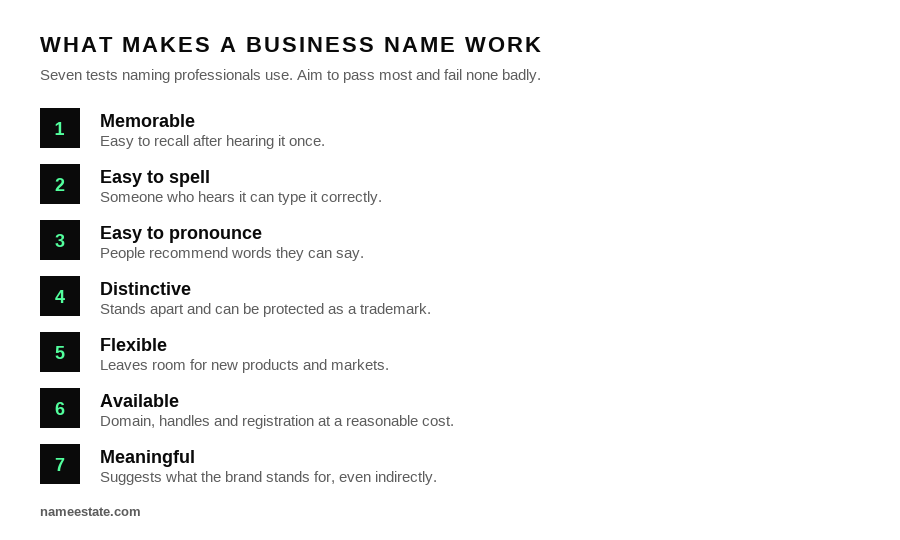
No candidate scores perfectly on every test. The aim is a name that fits the company’s strategy and does not fail any test badly. A good business name can be abstract, but it should never be confusing.
Start With the Brand, Not the Word List
Brainstorming without a brief tends to produce words that sound clever and say nothing. A name should follow the business idea, not lead it. Before writing a single candidate, it helps to answer five questions in writing:
- What does the company do, in one sentence a stranger would understand?
- Who is the customer, and what words do they already use for the problem?
- Which three adjectives should people associate with the brand?
- Who are the main competitors, and what naming patterns do they share?
- Where will the company operate in five years, with which products and in which countries?
The answers become the filter. A fintech serving small businesses in one country needs a different name than a consumer app planning to launch in ten languages. The brief also prevents the most common trap: falling in love with a word first and building the brand identity around it afterwards.
Types of Business Names
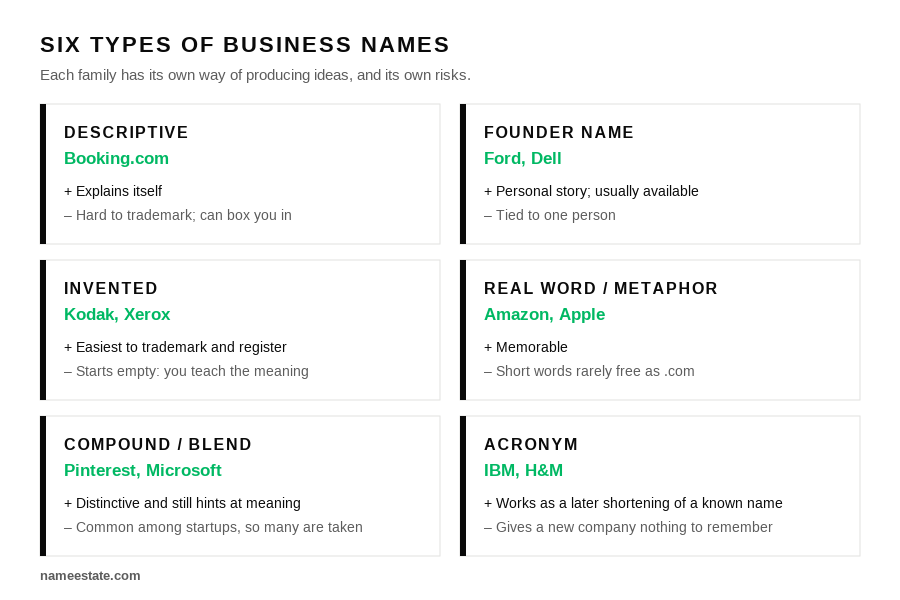
Most names fall into one of six families. Knowing them makes brainstorming faster, because each family has its own way of producing candidates and its own risks.
Descriptive Names
A descriptive label says what the company does: General Motors, The Home Depot, Booking.com. It explains itself instantly and can help early search visibility, but it is hard to protect as a trademark and can box the company in when it expands. Descriptive words are also the most likely to be taken already in their .com form.
Founder and Family Names
Ford, Disney and Dell all carry a founder’s surname. If you use your own name, the business gains a personal story and avoids most availability problems, but it ties the company to one person, which can complicate matters if you later want to sell your business or step back from it. For a consultancy or a design studio it can make sense to use your name outright; for a product company that hopes to be acquired, it is a heavier choice.
Invented Names
Kodak, Xerox and Häagen-Dazs were made up. George Eastman reportedly chose Kodak because he liked the letter K and wanted a short word that was hard to mispronounce. Invented names are the easiest to trademark and to secure as domains, but they start empty: the company has to teach the market what the word means.
Metaphor and Real-Word Names
Amazon, Apple and Slack borrow an existing word and give it a new meaning. Jeff Bezos dropped the company’s original name, Cadabra, partly because it was misheard as “cadaver”. Real words are memorable but competitive: short dictionary words are rarely available as .com domains and are often trademarked in related categories.
Compound and Blended Names
Facebook, Microsoft (from microcomputer software) and Pinterest (pin plus interest) combine two words or fragments. Blends can be distinctive and still hint at meaning, which is why they are common among startups.
Acronyms
IBM and H&M became known by their initials after decades of use under longer names. A new company that starts as a string of letters gives customers nothing to remember, so acronyms work best as a later shortening of an established business name, not as a starting point.
How to Generate Business Name Ideas
Volume comes first. Experienced namers often produce hundreds of candidates before shortlisting a handful, because most raw ideas fail an availability or meaning check. The following methods help create a business name list with real variety:
- Word banks. List words relevant to your business: the product, the customer’s outcome, the industry and the personality. Include synonyms, translations and related images. Many of the best candidates come from combining entries in this list.
- Combine and blend. Join two words from the bank, or merge fragments of them, the way Pinterest joined pin and interest.
- Borrow from other fields. Mythology, astronomy, geography, nature and science supply short, evocative words.
- Alter real words. Add a prefix or suffix, change an ending, or shorten a word.
- Use metaphor. Ask what the product is like rather than what it is: a bridge, a compass, a lighthouse.
- Look at other languages. Latin, Greek and many modern languages offer roots that sound fresh in English, but every foreign word needs a meaning check with native speakers.
- Brainstorm business names in groups. Time-boxed sessions with three or four people produce more variety than one founder alone, as long as nobody judges ideas during the session.
- Keep a running list. Good candidates appear at random moments, and a shared document captures them.
At this stage every business name idea goes on the list, however rough. Judging too early narrows the pool before the strongest options have had a chance to appear. Founders who want to learn how to come up with names faster usually improve by producing more candidates, not by agonizing over each one.
Using AI Tools and Business Name Generators
A business name generator takes a keyword and returns a list of combinations, often with domain availability attached. Traditional name generators work from fixed rules: prefixes, suffixes, rhymes and blends. Newer AI name generators run on large language models, which can follow a brief, adopt a tone and explain the logic behind each suggestion.
AI is good at breadth. Given a clear description of the company, the audience and the personality, an AI model can produce a long list of catchy business name ideas in seconds and refine them on request: shorter, more playful, more technical, nothing ending in -ly. That makes AI useful for the expansion phase of naming, especially for small business owners without a budget for a naming agency, or for founders who need a name for their business quickly.
AI is weak at judgment. A model does not know which names are trademarked, which domains are held by investors, or how a word sounds in the languages of future markets. Its suggestions also tend to converge on similar patterns, so the names it proposes may already be in use by other founders who asked a similar question. AI output is raw material for the shortlist, never a finished answer.
A free business name generator is a reasonable starting point, but it is worth checking how the tool makes money. Many generators are run by registrars or marketplaces and steer users toward domains they sell, so the name suggestions are not neutral even when the tool costs nothing. The same applies to a brand name generator bundled with a logo maker or a website builder.
Writing a Better Prompt
Output quality follows the brief. A useful prompt for an AI assistant includes:
- a one-sentence description of the product and the customer;
- three personality adjectives;
- competitors the name should not sound like;
- length limits and words to exclude;
- the markets and languages where the name must work;
- a request to explain the meaning behind each candidate.
Running the same brief through two or three different models widens the pool, and asking each model to criticize the others’ suggestions is a quick way to expose weak candidates.
How to Choose a Name From Your Shortlist
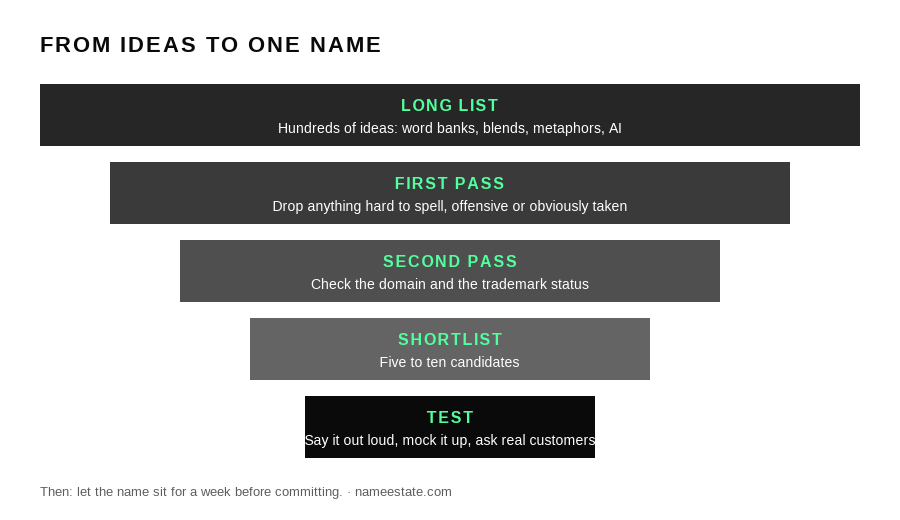
Once the long list has a few hundred entries, cut it in stages. A first pass removes anything hard to spell, offensive in a major language or obviously taken. A second pass checks the domain and trademark status of the survivors. What remains should be a shortlist of five to ten candidates for real testing.
Say the Name Out Loud
Many names die in conversation. Try each candidate in a sentence, on a phone call and as a reply to “What’s the company called?” If listeners ask how to spell it, or hear something else, that problem will repeat with every customer.
Test It in Context
Mock up the name and logo on a homepage, an app icon, an email signature and an invoice. A candidate that looks elegant on a whiteboard can feel weak in a crowded app store or an inbox.
Ask the Right People
Show the shortlist to people who match the target customer, not only to friends and investors. Ask what kind of company each candidate suggests, what it would sell and what it would cost. The goal is a name that resonates with buyers, not one that wins a popularity vote among colleagues.
Look Five Years Ahead
A name like “Boston Bike Repair” is clear today and limiting tomorrow. Ask whether each candidate still fits if the company adds products, moves into new cities or changes its model. Future business plans do not have to be certain to shape the decision; they only need to be possible.
Domain Name Availability and Extensions
For most companies the website address is part of the name. Customers type it, see it in search results and judge it in email signatures, and a custom business email address on the same domain signals that the company is established. Checking availability early saves effort on candidates that cannot be used online.
The .com extension remains the default expectation for many customers, particularly in the United States. Short, real-word .com domain names are almost always registered already, often by investors who sell them at a premium. That is why many startups launch on alternatives such as .io, .co, .app and .ai, which is the country-code extension of Anguilla but is widely used by AI companies.
Launching on an alternative extension is a legitimate choice, but it has a cost. Some visitors type the .com by habit, email can go astray, and the company may eventually decide that the stronger version of its own name is worth buying. Planning for that decision from the start, even if the purchase comes years later, avoids being surprised by it.
A useful reference point is the Domain Upgrades index on nameestate.com, which tracks funded startups on .ai, .io, .app and other extensions and lists the stronger version of their own name that is for sale right now, with its buy-now price. Browsing it shows how often well-funded companies launch on a compromise domain and what the upgrade costs in their category. The listed domains are offered by their current owners through the marketplace shown, not by the index itself.
Rules for a Domain That Works
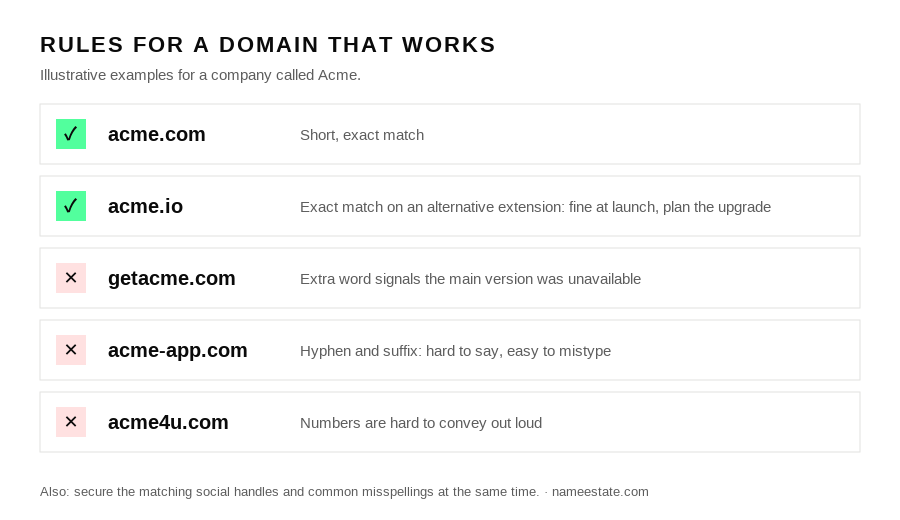
- Keep it short and easy to type.
- Avoid hyphens and numbers, which are hard to convey verbally.
- Match the domain to the exact name of the company where possible; extra words such as get-, try- or -app signal that the main version was unavailable.
- Register common misspellings and the main country-code extensions where the company operates.
- Secure the matching social handles at the same time.
Trademark Checks Before You Commit
A domain registration does not give the right to use a name commercially. In the United States, trademark rights come from use in commerce and can be strengthened by federal registration with the U.S. Patent and Trademark Office (USPTO). Before you use the name publicly, search the USPTO trademark database, which replaced the older TESS search system in 2023, for identical and similar marks in related classes of goods and services.
Similarity matters more than identity. A mark that sounds like an existing one in the same industry can be challenged even if the spelling differs. A proposed business name that clears a basic search should still be reviewed by a trademark attorney before significant money goes into signage, packaging or advertising. Outside the United States the equivalent searches run through the EUIPO for the European Union and through national offices elsewhere.
It is also worth searching the web, app stores and social platforms. Unregistered businesses can hold common-law rights in the areas where they operate, and those rights do not show up in a federal database.
How to Register Your Business Name
Registration rules depend on the country, the state and the business structure. In the United States, the most common paths are:
- Entity name. Forming an LLC or corporation with a state registers the legal name of the business entity in that state. Each state checks that the name is distinguishable from entities already on its records.
- Assumed name (DBA). A company that operates under a name different from its legal name usually files an assumed name, also called a “doing business as” (DBA) or trade name, with the state or county.
- Federal trademark. Registration with the USPTO protects the mark nationally in the classes it covers, which state registration does not.
State registration and trademark protection are separate. A registered business name in one state does not stop a company in another state from using it, and it does not prevent a trademark owner from objecting. Requirements change, so the current rules should be confirmed with the relevant Secretary of State or a local attorney.
Common Mistakes When Choosing a Business Name
- Picking a name that is too narrow. A geographic or product-specific label can limit expansion.
- Copying a competitor’s pattern. If every company in the category ends in -ify, one more -ify name blends in.
- Relying on misspellings. A creative business name that drops vowels made sense when domains were scarce; today it mostly creates confusion.
- Ignoring other languages. A word that is harmless in English can be awkward or offensive elsewhere.
- Skipping the trademark search. Rebranding after a cease-and-desist letter costs far more than a search.
- Choosing something nobody can pronounce. Word of mouth depends on people being able to say it.
- Settling on a weak domain without a plan. A compromise address is acceptable at launch when it is a deliberate choice, not a forgotten one.
- Letting ego decide. The company name should serve customers first, not the founder’s taste.
Business Name Ideas by Industry
Naming conventions differ by sector, and knowing them helps decide whether to follow the pattern or break it.
Professional Services
Law firms, accountancies and consultancies have traditionally used partners’ surnames, which signal accountability and continuity. Newer firms increasingly choose short abstract words instead, because those names survive partner changes and travel better across borders. Whichever route is chosen, clients in these fields respond to names that sound stable and serious.
Software and Technology
Software companies favor short invented words, blends and real words used out of context. Because so many startups compete for the same short words, availability drives much of the choice: founders often accept an alternative extension, a prefix such as get- or a slightly longer word to secure a usable domain. Names in this sector also need to work as app icons, command-line tools and API names, which rewards brevity.
Consumer Products and Retail
Consumer brands lean on emotion and sound. Names that are pleasant to say, easy to remember and suggestive of a feeling tend to perform well on packaging and shelves. Shoppers often meet the product before the website, so the name has to carry the whole story in a second or two.
Local Service Companies
Plumbers, cleaners, salons and restaurants often benefit from clarity, because customers search for a service in a place. A clear label that includes the service can help local search and word of mouth. The trade-off is flexibility: a company that adds services or moves to new towns may outgrow a label tied to one service or neighborhood.
Examples of a Great Business Name and Why They Work
- Google plays on googol, the number written as 1 followed by 100 zeros, a hint at the scale of information the search engine set out to organize.
- Lego comes from the Danish phrase leg godt, meaning “play well”.
- Airbnb began as AirBed & Breakfast and was shortened as the company moved beyond air mattresses.
- Amazon replaced Cadabra with the name of the river that carries more water than any other, a hint at scale.
Each started with a strong idea and was refined. A unique business name rarely appears fully formed; it is usually shaped by testing and, sometimes, by renaming. The ideal name is often the third or fourth version of an early idea, not the first.
Will the Name Support Business Growth?
A name chosen for a side project often has to carry a funded company later. It is worth asking how the name will perform when the company raises money, hires senior staff, enters new markets or gets acquired. Investors, recruits and acquirers all see the name and the domain before they see the product.
Some founders keep the original name and upgrade the domain; others rename entirely. Renaming is possible, but it costs time, redirects, legal filings and customer confusion. The name needs to hold up at ten times the current size, and a strong name selected with growth in mind reduces the chance of either change.
Renaming an Existing Company
Sometimes the right moment to rethink a name comes after launch. Common triggers include a trademark conflict, expansion into markets where the current name has an awkward meaning, a pivot that makes the original label misleading, or the chance to buy a much stronger domain.
A rename works best when it is treated as a project rather than an announcement. Inventory every place the old name appears, from contracts and bank accounts to app store listings and email signatures. Set up permanent redirects from the old domain to the new one, update structured data and search console properties, and tell customers why the change happened. Companies that move to a better version of their existing name, for example from an alternative extension to the matching .com, face a much lighter version of this work, because the name itself stays the same.
A Checklist for Finalizing Your Business Name
Before settling on a name for your business, run through these checks:
- People can spell it after hearing it once.
- It fits the brand brief and the five-year plan.
- The domain is available, or there is a realistic plan to acquire the stronger version later.
- Social handles are available, or close variants are.
- A trademark search shows no conflicting marks in related classes.
- The name is available for entity registration in the home state.
- It has been checked for meaning in the main languages of future markets.
- It still feels right after a week: let your business name sit unannounced for a few days before committing.
When every box is checked, make your name official in the right order: register the entity or DBA, file the trademark application if the budget allows, secure the domain and handles, then update everything else. That sequence protects the new business name before it becomes public.
Frequently Asked Questions
How long should a company name be?
There is no fixed rule, but shorter names are easier to remember, type and fit into a logo. Many well-known brands use one or two syllables, and names longer than three words are hard to fit into an app icon or a social handle.
Can two companies have the same name?
In some circumstances, yes. Companies in unrelated industries can share a word if consumers are unlikely to be confused, which is why trademark searches focus on related classes. Within the same state, entity registration usually requires a distinguishable name. A trademark attorney can assess a specific case.
Should the name include keywords?
Keywords can help a local service company, but search engines rank pages on content and authority, not on the words in the brand. For most companies, a distinctive name backed by useful content is the safer long-term choice than a keyword-heavy one.
Is it worth buying a premium domain?
It depends on the stage of the company and the gap between the available address and the one it really wants. A premium domain is a one-time cost that can reduce lost traffic and confusion, but it should never delay launch. Many companies launch on an available address and upgrade once revenue or funding justifies the purchase.
The Bottom Line
There is no perfect business name, only one that fits the company, clears the legal checks and can grow with it. A disciplined process, a broad list of ideas, honest testing and early availability checks produce a captivating business name far more reliably than waiting for inspiration, and they help founders land on a name they will not want to replace in two years.
Treat the name of your business and its domain as one decision. Before finalizing, a look at the Domain Upgrades index on nameestate.com shows how funded startups on .ai, .io and .app compare with the stronger versions of their own names, a useful benchmark for deciding whether to launch on an alternative extension or to invest in the better address from day one.
Is the stronger version of your startup's name for sale? Browse the Domain Upgrades index »