
What Is SEC Form D? SEC Form D Instructions, Filing Rules and How to Search the Filings
Most startups raise their first outside money without ever registering a stock offering. They sell shares, SAFEs or convertible notes privately, to angels and funds, and each of those is a security under federal law. The sale happens under an exemption from federal registration, and that choice comes with one piece of paperwork almost every founder meets sooner or later: SEC Form D, a short public notice that tells regulators an exempt offering is under way.
The deadline arrives quickly and without much warning. The clock starts when an investor first becomes contractually committed, not when the round closes or the money lands, so a company can owe a filing before the last signature on the round is in. Late or missing notices rarely make headlines, but they can create problems with state regulators and with the next investor's lawyers during due diligence.
This guide explains what Form D is, who files it and when, what each item on the form asks for, how amendments and state filings work, and how to find any company's filings on the SEC's database. It closes with what a Form D does and does not tell an outsider about a startup, which is how NameEstate uses these filings to list recently funded companies.
What Is Form D? The SEC Form for an Exempt Offering
In the SEC's own words, Form D is used to file a notice of an exempt offering of securities. The key word is notice. A registered public offering, such as an IPO, requires a full registration statement that the Securities and Exchange Commission reviews before shares are sold. A private offering skips that process because it fits one of the legal exceptions written into federal law, and Form D is how the company tells the government it is relying on one of them.
Put simply, Form D is a notice, not an application and not a registration. The company does not ask permission to raise money with it. It is a notification to the SEC, made after the fact, that it has started selling securities privately, and it gives basic facts about the company, the people behind it and the offering itself.
The rules that require the notice sit mostly in Regulation D, a set of rules adopted under the Securities Act of 1933. A Regulation D exemption lets a company raise money without registering the offering, as long as it follows the conditions of the specific rule. Private placements of this kind are the normal way startups handle raising capital before they are large enough, or old enough, for a public offering.
Two facts make Form D useful well beyond compliance. The notice is filed electronically and becomes public, so anyone can read it. And the form is standardized, so every private raise reports the same fields in the same places. That is why journalists, funds and data services read new Form Ds every day, and why a founder should assume the details in a notice will be seen.
Who Must File: The Exemption Claimed and Rule 504 or 506
The form's general instructions answer the question directly: each issuer that sells its securities in reliance on an exemption in Regulation D or in Section 4(a)(5) of the Securities Act must file the notice. The issuer is the company selling its own stock, notes or SAFEs, usually the startup itself. If the company raises money under a different rule, or only through a registered offering, no Form D filing is required for that offering.
Item 6 of the form, Federal Exemptions and Exclusions Claimed, is where the issuer names its legal basis. For startups, the exemption claimed is almost always one of the four options below:
Rule 504
Rule 504 covers smaller offerings, subject to a dollar cap over a 12-month period set in the rule itself. Some state rules still apply to these offerings, which is one reason most venture-backed startups rely on Rule 506 instead.
Rule 506(b)
Rule 506(b) is the classic private placement exemption. There is no cap on the amount raised, the company may not use general solicitation to market the offering, and it can sell to any number of accredited investors and, under conditions set out in the rule, to a limited number of non-accredited purchasers who meet a sophistication test.
Rule 506(c)
Rule 506(c) allows general solicitation, so the company can talk about the raise publicly, but every purchaser of the security must be accredited and the issuer must take reasonable steps to verify that status. Founders who announce a round on social media before it closes often end up here.
Section 4(a)(5)
Section 4(a)(5) is a statutory route for offerings made only to accredited investors, without public advertising, up to a dollar limit set in the statute. It appears far less often in startup filings.
Choosing the rule is a legal decision for the company's counsel, made before anything is sold. The notice simply records the choice. What matters for the founder is that the choice has consequences for what the company may say publicly about the raise, and for who may invest.
When to File a Form D: Within 15 Days of the First Sale
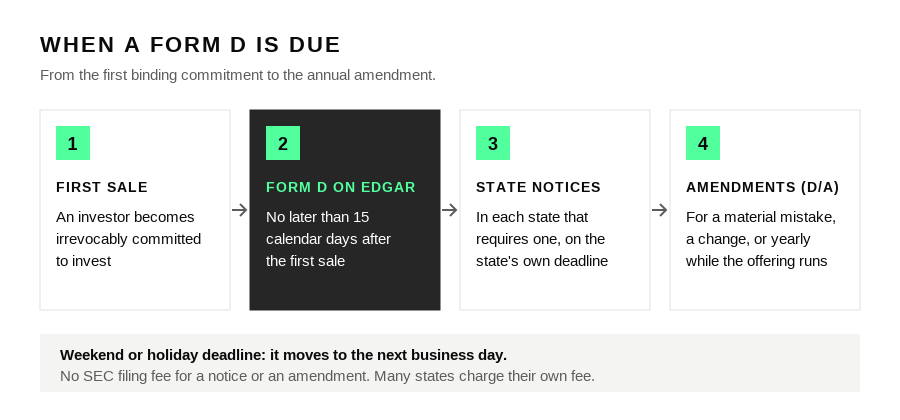
The timing rule is short. A new notice must be filed for each new offering of securities, and Form D must be filed no later than 15 calendar days after the date of first sale of securities in the offering. If the deadline falls on a Saturday, Sunday or federal holiday, it moves to the next business day.
The definition of the trigger is where founders get caught. The instructions define the date of first sale as the date on which the first investor is irrevocably contractually committed to invest. Depending on the contract, that can be the day a subscription agreement or a SAFE is signed, even if the wire arrives later. It is not the day the round is announced or the day the last investor joins.
Three practical consequences follow:
- A rolling close still has one start date. In a round that closes over several months, the 15-day window runs from the earliest investor commitment, not from each closing.
- File Form D no later than the deadline, even if the round is still open. The form asks how much has been sold so far, so a company files with the numbers as of the filing date and updates them later if an amendment becomes due.
- Each new offering is a new notice. A seed round and a later Series A are separate offerings, each with its own filing and its own date of the first sale.
Filing Form D with the SEC costs nothing: the SEC does not charge a fee for a notice or for an amendment. States are different: many collect their own fees for their notice filings, covered below.
What the Form D Filing Asks For, Item by Item
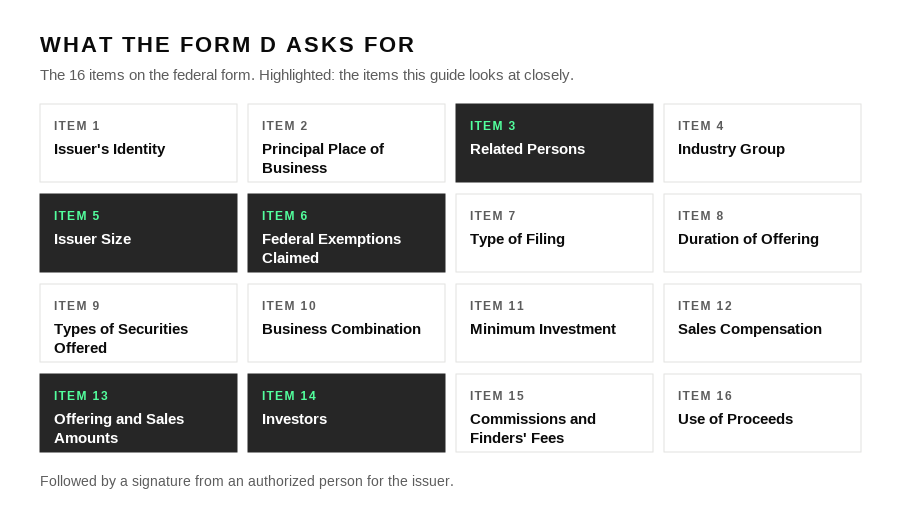
The form itself is only a few pages long, and the official instructions walk through every item. Most of the answers come from documents the company already has: its charter, its cap table and the terms of the round. Here is what the federal form asks for, in order:
- Issuer's Identity. The legal name, the jurisdiction and year of incorporation, the entity type and any previous names.
- Principal Place of Business and Contact Information. A street address and phone number.
- Related Persons. Names and addresses of the company's executive officers, directors and promoters, with the relationship of each.
- Industry Group. One category from a fixed list, such as Biotechnology, Other Technology or Pooled Investment Fund.
- Issuer Size. A revenue range for operating companies, or an aggregate net asset value range for hedge funds and other investment funds. Both lists include a Decline to Disclose option.
- Federal Exemptions and Exclusions Claimed. The rule the offering relies on.
- Type of Filing. New notice or amendment, and when the first sale happened, or a note that it has yet to occur.
- Duration of Offering. Whether the offering is expected to last more than one year.
- Types of Securities Offered. Each type is marked from a fixed list: equity, debt, options or warrants, pooled investment fund interests and others.
- Business Combination Transaction. Whether the offering is tied to a merger or acquisition.
- Minimum Investment. The smallest investment accepted from an outside investor.
- Sales Compensation. Brokers or placement agents paid in connection with sales, and the states where they solicit.
- Offering and Sales Amounts. The total offering amount, the total amount sold and the total remaining to be sold.
- Investors. Whether people who are not accredited have bought or may buy, the number of non-accredited investors who have already invested, and the total number of investors so far.
- Sales Commissions and Finders' Fees Expenses. Amounts paid to brokers and finders.
- Use of Proceeds. How much of the gross proceeds has been or will be paid to the officers, directors or promoters named in Item 3.
A signature block follows, signed by an authorized person for the issuer. The form carries a warning on its first page that intentional misstatements or omissions of fact are federal criminal violations, so every answer should match the company's records.
Amount offered and amount sold
Item 13 deserves a closer look because it is the number outsiders quote. The total offering amount is the dollar amount of securities being offered under the rule claimed in Item 6. The total amount sold is what has actually been sold as of the filing date. The form also allows the amount offered to be marked Indefinite when it cannot be calculated yet, for example when a security will be issued on the exercise of another security at a price not yet known.
Issuer size and Decline to Disclose
The revenue range in Item 5 runs from No Revenues through bands that start at $1 - $1,000,000 and end at Over $100,000,000. Many startups choose Decline to Disclose, which the form allows. Founders sometimes worry that skipping the disclosure looks evasive; in practice it is the most common answer among private companies, and it reveals nothing on its own.
Initial Filing on EDGAR: Submitting Form ID, Then the Notice
All Form D notices and amendments are filed online through EDGAR, the SEC's electronic filing system. There is no paper option for this form. A company that has never filed anything with the agency first needs EDGAR access, which begins with an application for the codes that let a filer submit documents. The exact access steps changed with recent updates to EDGAR, so the agency's filer pages are the place to check the current process before the deadline is near.
The order of work for a first-time filer usually looks like this:
- Get EDGAR access early. Access is not instant, and the 15-day window is short. Applying when the term sheet is signed, rather than after the first close, removes most of the deadline risk.
- Collect the facts. Related persons and their addresses, the rule relied on, the security type, the amounts sold so far and the investor count.
- Complete the online form. EDGAR presents the items as a web form; most law firms and filing agents file it on the company's behalf.
- Submit and save the confirmation. Keep a copy of the accepted filing with the round documents.
- File in the states. The federal notice does not cover the states, as explained below.
Companies must file Form D to comply with the federal rule, and Form D requires issuers to give current information in every item, including in amendments. Treat the notice filing with the SEC as part of the closing checklist, not as an afterthought weeks later.
Founders often ask whether they can file Form D themselves. Nothing in the form requires a lawyer, and the questions are factual. Most startups still let counsel or a filing agent handle it, because the same lawyer is choosing the rule and drafting the round documents, and because a mistake in Item 6 or Item 13 is easier to avoid than to fix.
Amendments: When to Amend a Form D
A company may amend a previously filed form at any time. In three situations it must:
- To correct a material mistake of fact or error in the earlier notice, as soon as practicable after the mistake is found.
- To reflect a change in the information provided in the earlier notice, as soon as practicable after the change, except for the changes listed below.
- Annually, on or before the first anniversary of the most recent previous filing, if the offering is still continuing at that time.
The instructions also list changes that do not require an amendment. Among them: any change that occurs after the offering has ended; a change only in the address or relationship of a related person; a change in the issuer's revenues or aggregate net asset value; and certain changes in the minimum investment amount, the total offering amount and the amounts paid to related persons when they stay within limits the instructions set, such as an increase in the offering amount of no more than 10%.
An amendment is not a short update to the initial form. It must give current information for every item on the form, whatever the reason for filing it. In the filing list, amendments appear with the form type D/A next to the original D, which makes the history of an offering easy to follow.
The annual amendment is the filing requirement founders forget most often. An offering that stays open for more than a year, such as a long SAFE program, needs a fresh notice on or before the anniversary of the last one.
State Notice Filings and Blue Sky Compliance
Federal law limits what states can require for most Rule 506 offerings, but it does not remove the states entirely. Most states require their own notice filing, usually a copy of the federal notice plus a state fee, filed within a deadline the state sets. The form's instructions say the issuer must file the notice with the SEC and with the states requiring it, and point to the North American Securities Administrators Association for state filing information.
Many states accept these notices through NASAA's Electronic Filing Depository, a shared online system that lets one submission reach several states. The state securities rules that sit behind these filings are often called blue sky laws.
State notice filings are driven by where each investor lives, not where the company is incorporated. A Delaware company whose backers are in California, New York and Texas generally looks at the requirements of those three states. Item 12 of the form, which lists the states where sales agents solicit, is a separate question.
Two compliance points matter here. Some states set deadlines tied to the first sale in that state, so a round with backers in many states can have several dates to track. And a missed state filing is usually curable, but it can mean late fees and questions during the next financing.
How to Search Form D Notices on EDGAR
Every Form D notice ends up on the SEC’s EDGAR system, and searching it is free. Two tools do most of the work:
Company search
The company search lets anyone type a company name or ticker and see its filings. A private startup that has filed only these notices will show a short list, usually a D for each offering and a D/A for each amendment, each with its filing date. Opening a filing shows the form exactly as submitted, with every item described above.
Full-text search
The full-text search covers the text of electronic filings since 2001 and can be filtered by filing type and date range. It is useful when the legal name is unknown, because it can find a brand name, a founder's name or a city inside the documents.
A few tips make a Form D search faster:
- Search the legal name. Filings use the legal entity name, which may differ from the product or brand name.
- Look for the D/A. The newest amendment has the most current numbers.
- Read Item 13 and the dates together. The amount sold is as of the filing date, so an early notice can understate the final round.
- Check the related persons. Item 3 lists officers and directors by name, which helps confirm that a filing belongs to the company you think it does.
What a Form D Tells You About a Startup, and What It Doesn't
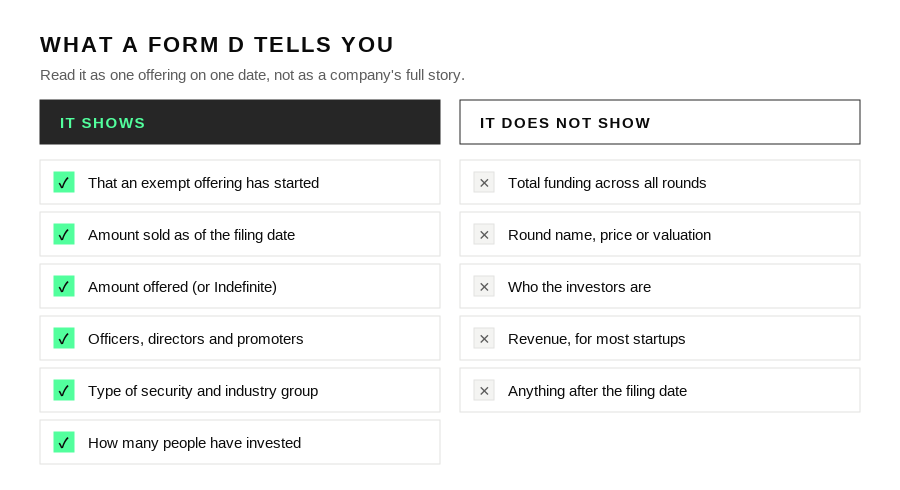
For a prospective investor or a competitor, a new notice is one of the earliest public signs that a startup has raised money. A Form D signals that an offering has started, roughly how much has been sold so far, who runs the company and which rule it relies on. It does not tell the whole story, and reading it as if it did is the most common mistake.
What it shows:
- That the company has made sales under an exemption, and the date it was filed.
- The amount sold in that offering as of the filing date, and the amount offered.
- The names of the officers, directors and promoters.
- The type of security sold, the industry group and how many people have invested so far.
What it does not show:
- Total funding. Each notice covers one offering. A company with a seed round and a Series A has at least two filings, and neither number is the total raised.
- The round name, the price per security or the valuation. The form has no field for Series A, seed or valuation. Any round label attached to a filing is someone's estimate.
- Who invested. No investor is named: investors are counted, not listed. A fund that leads a round does not appear on the company's form.
- Revenue, in most cases. Many startups decline to disclose their revenue range.
For an investor doing diligence, the filing is a starting point to compare against the company's own account of its rounds. For a founder, it is a reminder that the basic facts of a raise become public within weeks of the first commitment.
Form D for SAFE and Convertible Note Rounds
Many seed rounds are raised on SAFEs or convertible notes rather than priced shares, and founders sometimes assume a notice is only needed for a priced round. The form makes no such distinction. A SAFE or a note is a security, so a sale of one under Rule 506(b), Rule 506(c) or another exemption covered by Regulation D triggers the same notice, on the same 15-day clock, as a sale of preferred stock.
Two parts of the form need care in these rounds. Item 9 asks for the type of security, and the right box depends on the instrument's terms: a convertible note is debt, while a SAFE is usually described as a right to acquire another security. Counsel normally makes that call. Item 8 asks whether the offering will last more than one year, and SAFE programs that stay open to new money for many months often do, which brings the annual amendment into play.
When the SAFEs later convert into preferred stock in a priced round, the priced round is usually a new offering with its own notice. Reading a startup's filing history with this in mind explains why one company can show several notices within a year or two.
How NameEstate Uses Form D Data
NameEstate's index of funded startups reads new Form D notices every day. For each company it shows the amount the company reported as sold in that filing, labeled as the amount reported in its SEC Form D filing for that offering, never as total funding. A company is listed only after its website is matched to the filing, using an executive named in the filing or the phone number in the filing. The listing links to the filing itself, so any investor or reader can check the number at the source.
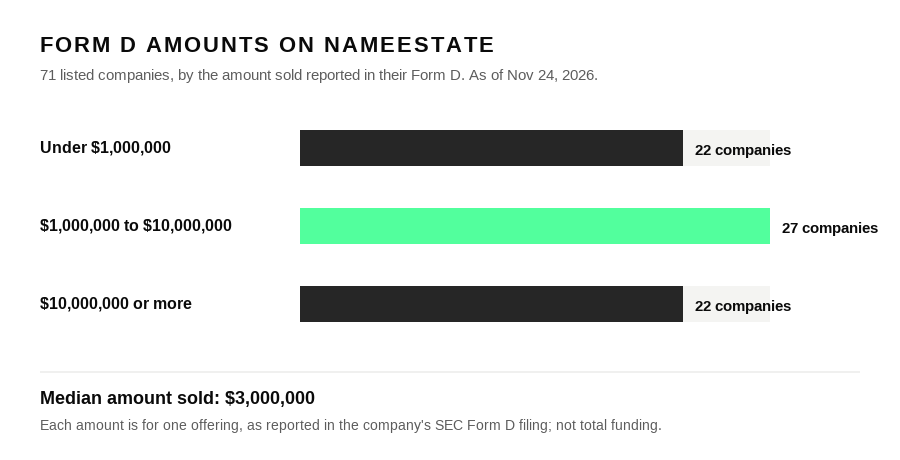
As of Nov 24, 2026, the index lists 71 companies with a Form D amount. The median reported amount sold is $3,000,000; 22 companies reported less than $1,000,000, 27 reported between $1,000,000 and $10,000,000, and 22 reported $10,000,000 or more. Some recent examples from the index:
- Generalist AI, an AI software company in San Francisco, reported $198,224,662 sold in a filing dated Aug 24, 2026.
- Nuance Labs, an AI software company in Seattle, reported $46,699,985 sold in a filing dated Mar 26, 2026.
- Allium Labs, a crypto company in New York, reported $39,999,994 sold in a filing dated Jul 28, 2026.
The reason a domain site reads securities filings is simple: a fresh raise is often the moment a startup can afford a stronger domain. Each listing pairs the company with a better version of its own name that is for sale today. Generalist AI runs on generalistai.com, and generalist.app was listed on Atom at $3,299 (price checked Nov 19, 2026). Allium Labs runs on allium.so, and allium.app was listed at $6,299 (price checked Nov 19, 2026). Browse recently funded startups from A to Z or by industry to see whether your company, or a competitor, is already on the list.
Common Form D Compliance Mistakes
Most problems with Form D come from timing and from treating the notice as a one-time event. The ones that come up most often:
- Counting from the wrong date. The deadline runs from the first binding commitment, not from the closing or the announcement.
- Waiting for EDGAR access. A company that applies for access after the first sale can run out of time before the codes arrive.
- Forgetting the states. The federal notice does not satisfy the state where each investor lives.
- Missing the annual amendment. Offerings that stay open past a year need an updated notice by the anniversary.
- Announcing a 506(b) round. Public marketing of a round can be general solicitation, which 506(b) does not allow; talk to counsel before posting about a raise in progress.
- Mismatched names. Related persons listed with nicknames or outdated titles make the filing harder to match and can raise questions later.
- Treating it as private. Every answer on the notice becomes public on the SEC website; there is no confidential version.
Form D Filing Checklist for Founders
A short checklist, to use when the term sheet is signed:
- Confirm with counsel which exemption the round relies on, and what that means for talking about the raise publicly.
- Open an EDGAR account if the company has never filed.
- Write down the date the earliest investor becomes irrevocably committed, and the date 15 days later.
- Collect names and addresses for every officer, director and promoter.
- Decide whether to disclose a revenue range or choose Decline to Disclose.
- File Form D on EDGAR, then the state notices for every state where an investor is located.
- Put the annual amendment date on the calendar if the offering may stay open for more than a year.
- Keep Form D records together: a copy of Form D as filed, each acceptance confirmation and the round documents, ready for the next investor's due diligence.
Bottom Line: Filing Form D on Time
Form D is the federal notice behind almost every private startup round: short, free to file with the SEC, due within 15 days of the first binding commitment, and public as soon as it is filed. Most of the work is in the timing, the state notices and the amendments, not in the form itself.
Once a notice is public, it becomes part of how the market sees the company, including the startups and funds who follow new raises. If your company has just filed, the Domain Upgrades index shows whether a stronger version of your startup's name is for sale right now, with its price and the date it was checked.
Is the stronger version of your startup's name for sale? Browse the Domain Upgrades index »